ServicesPatios
Concrete Patios in Fountain Valley
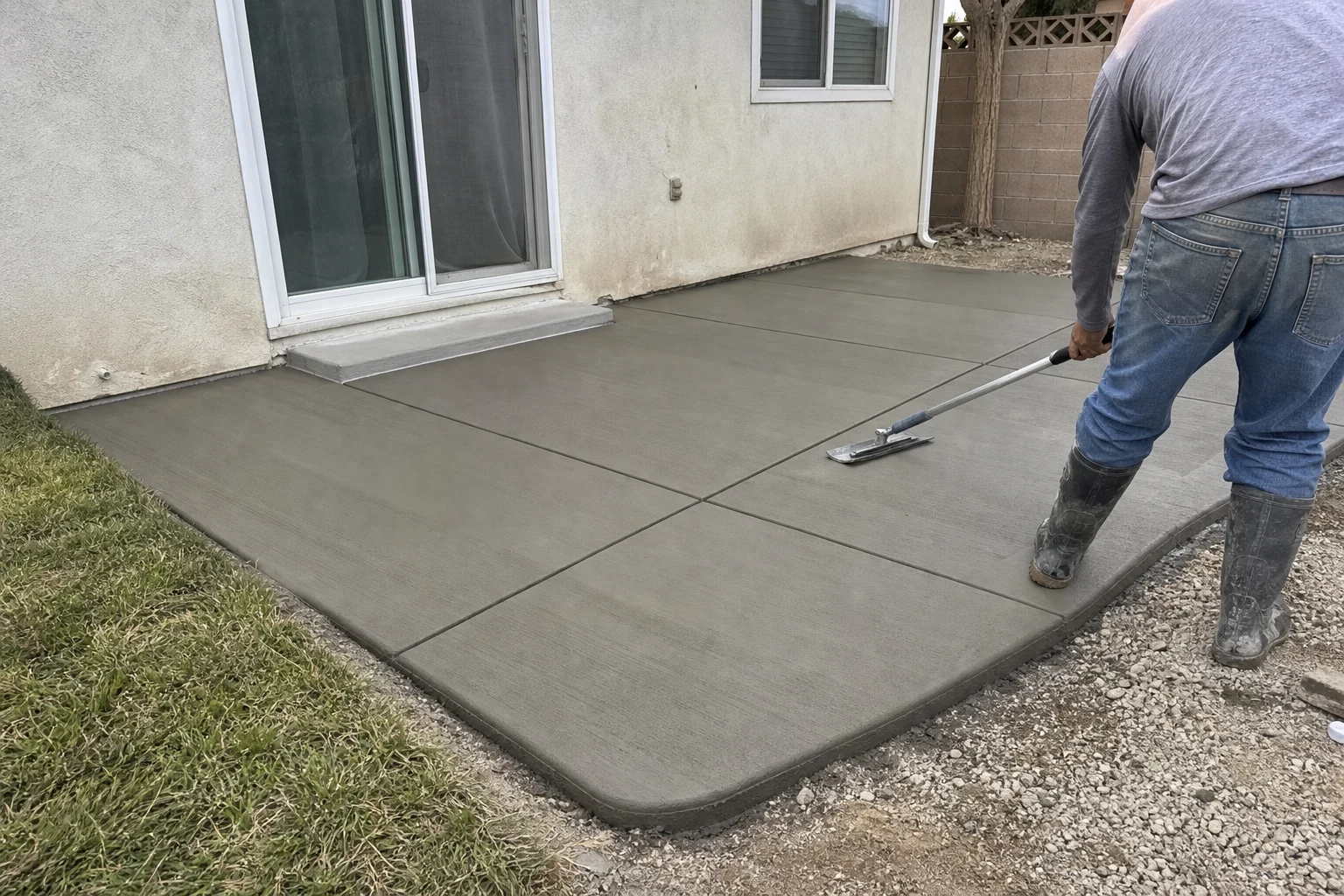
We pour concrete patios that shed water away from your home, sit flush with the door threshold and carry a finish your family can walk on barefoot or wet. You get a flat, solid outdoor floor without trip lips, ponding or slick spots.
A patio is a floor, so we build it like one
Most patio problems trace back to three things done badly before the truck arrives: soft base, no slope and joints in the wrong place. A slab poured on loose fill settles unevenly, and the low corner becomes a puddle and a toe-catcher. A slab poured dead flat sends rain toward your foundation and leaves a film of algae near the door.
We start below the surface. We excavate to firm soil, compact a gravel base, set reinforcement on chairs so it sits mid-slab, and form a gentle fall of about a quarter inch per foot away from the house. That slope is barely visible, but it keeps water off the slab and out of your walls.
If you want a decorative surface, our stamped concrete page covers pattern and color options. For larger outdoor layouts that tie a patio into paths and planters, see concrete backyards.
What every patio we pour includes
Excavation and compacted base
We strip out sod, roots and organic topsoil, then lay crushed aggregate and compact it in thin lifts. Clay-heavy soil is common in this part of Orange County, and it gains and loses volume with each wet winter and dry summer. A well-built base absorbs that movement so the slab above stays put.
Steel reinforcement on chairs
Rebar or welded wire mesh gets raised on chairs to the middle of the slab's depth. Steel resting on the dirt adds nothing; steel held mid-slab keeps any crack from opening up.
Drainage slope and threshold height
The finished surface sits below your door threshold and falls gently away from the wall. Water stays outside, and there is no raised lip at the slider for someone to catch a toe on.
Control joints at planned spacing
Curing concrete shrinks, and that stress has to release somewhere. We lay out a joint grid matched to the slab thickness, so the crack follows a straight, planned line rather than running across the open floor.
Slip-resistant finish and safe edges
A broom finish or light texture holds traction when sprinklers or a garden hose leave the surface wet. We tool every edge to a rounded profile so there is no sharp corner waiting for a shin or bare foot.
When an old patio has reached its end
Puddles that sit against the wall
If water lingers along the stucco after the sprinklers run, the slab has settled or was pitched toward the house. That standing moisture breeds mildew and can wick into the wall and framing behind it.
Panels out of level
One section riding above its neighbor creates an edge that catches feet. Usually the base has eroded or the soil has shifted, and removing the slab and rebuilding the base is the fix that lasts.
Cracks a heel can drop into
Fine shrinkage lines are part of how concrete behaves. A crack wide enough to hold a coin, or one that grows each season, tells you the slab no longer has solid support underneath.
Polished, flaking or slippery surface
A steel-troweled surface that has worn glossy turns slick when wet. Where the top paste has flaked off, exposed stone leaves a rough and uneven floor.
Shifting pavers or bare dirt
Loose pavers rock underfoot and fill with weeds, and an unpaved yard sends mud into your home. A single poured slab gives you one level, continuous surface.
How a patio job runs
- 1
Site visit and layout
We measure, check door thresholds and downspouts, and probe the soil. You get a written estimate that lists base depth, slab thickness, reinforcement and finish line by line.
- 2
Demolition and excavation
Old concrete is broken out and hauled away. We wet-cut where saws are needed to keep silica dust down, and we tape off the work area so kids and pets stay clear.
- 3
Base, forms and steel
We compact the base, set forms to the planned slope and place reinforcement on chairs. You can see the setup before any concrete arrives.
- 4
Pour and finish
Concrete is placed, screeded, floated and given its final texture while it is still workable. Edges get rounded and joints are tooled or saw-cut at the right time.
- 5
Cure and cleanup
We keep the slab moist or apply a curing compound so it gains strength evenly. Forms come out, debris leaves with us, and we tell you when it is ready for foot traffic and furniture.
What moves the cost of a patio
Patio pricing comes down to how much concrete goes in, how much work happens before the pour, and what the surface looks like at the end. We price each line separately so you can see exactly where the money goes and decide what matters to you.
- Size and thickness
- Square footage and slab depth set the volume of concrete and steel. A thicker slab costs more but suits heavy planters or an outdoor kitchen.
- Demolition and soil prep
- Breaking out an old slab, hauling it and building up a deeper base on soft clay adds labor and material.
- Access to the backyard
- A narrow side yard may mean wheelbarrows or a pump instead of chuting straight from the truck.
- Finish and color
- A broom finish is the most direct option. Integral color, exposed aggregate or a stamped pattern adds materials and finishing time.
Patio questions we hear often
Something not covered here? (714) 617-7914
How long before I can walk on my new patio?
Light foot traffic is usually fine after a day or two. Patio furniture and grills should wait about a week. Concrete keeps gaining strength for roughly a month, so we suggest holding off on anything very heavy until then.
Will my patio crack?
Concrete shrinks as it cures, so some cracking is expected. Control joints, a compacted base and properly placed steel make sure cracks happen in the joints and stay tight. That is why we plan joint spacing before the pour.
Is a broom finish slippery around the hose and sprinklers?
A broom finish is one of the grippiest surfaces for concrete. The fine ridges give shoes and bare feet traction even when wet. Sealers can reduce grip, so if you want one we add a non-slip additive.
Can the new patio connect to my walkway or side yard?
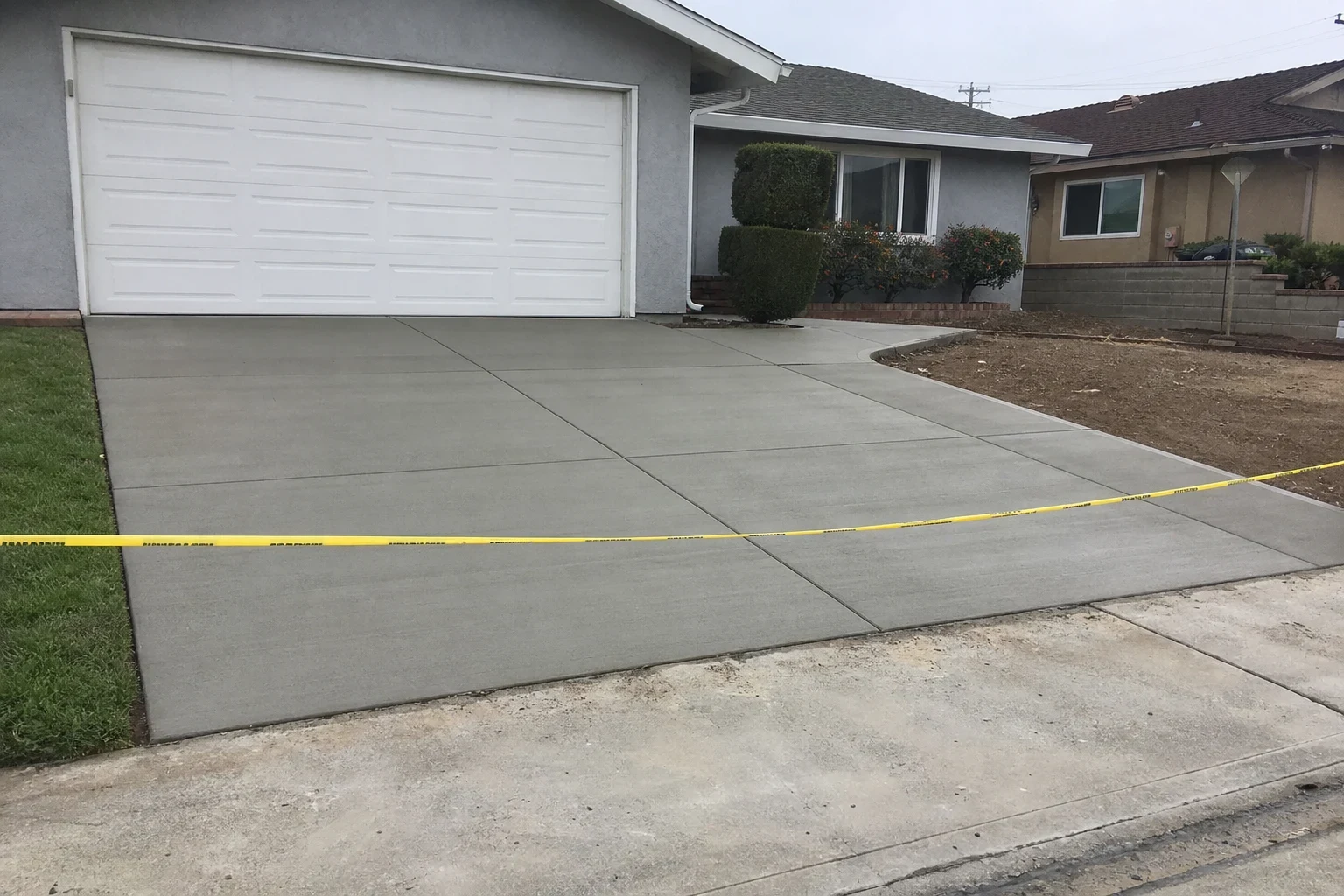
Yes. We often pour a patio along with walkways and sidewalks or a concrete side yard so grades line up and there are no step-ups between surfaces. We separate them with expansion material so each slab can move on its own.
Do I need to be home during the pour?
Not necessarily. We do need access to the yard and water, and pets should be kept inside. Fresh concrete is easy to mark, so we ask that everyone stays off the slab until we give the all-clear.
Ready for a patio that drains and grips
Tell us the size you have in mind and what you plan to put on it. We will talk through base, slope and finish, then schedule a visit to measure.