ServicesConcrete Pool Decks
Concrete Pool Decks in Fountain Valley
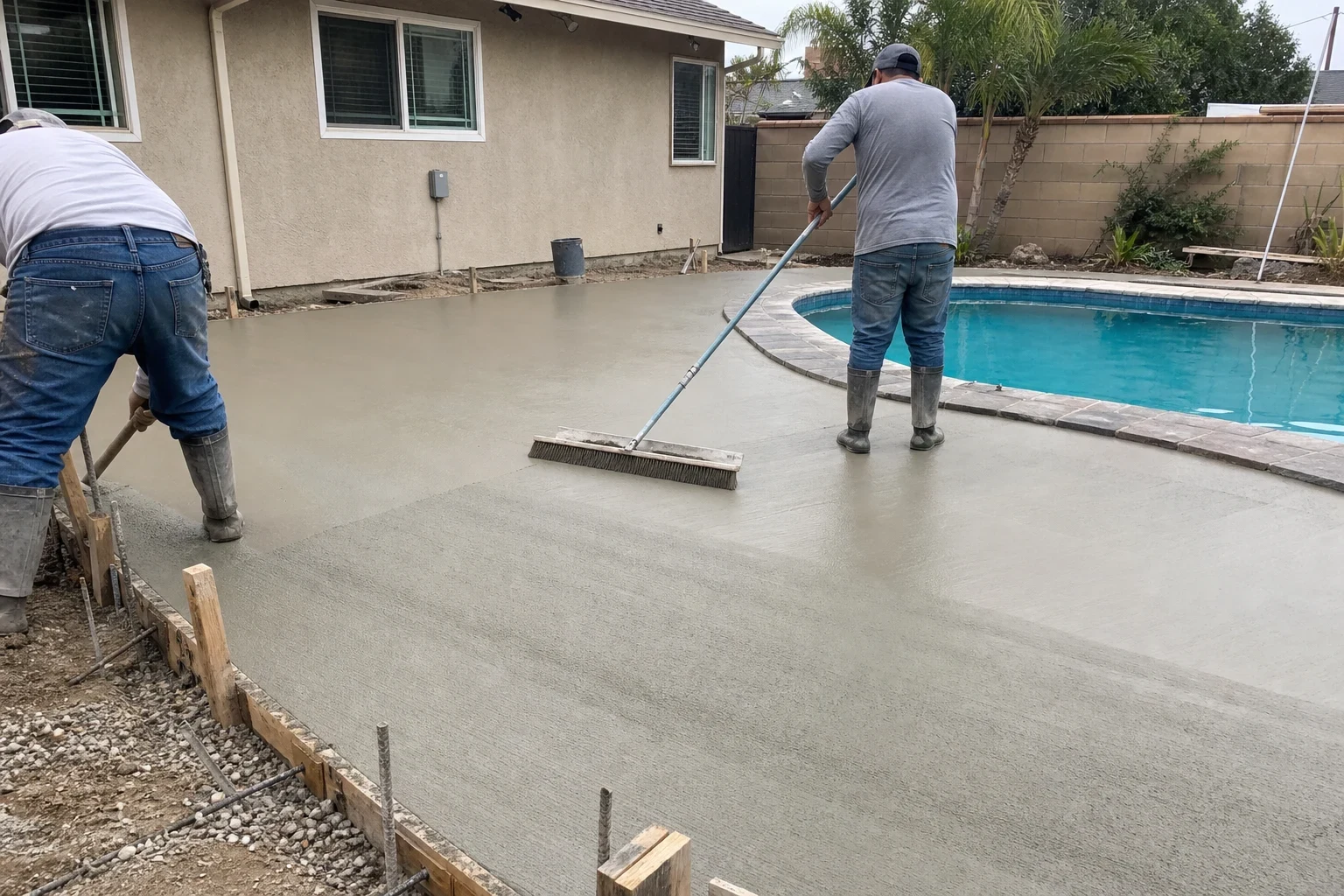
We remove worn, lifted or slick pool decks and replace them with new concrete that grips under wet feet, falls steadily away from the water and meets the coping at a sealed, flexible joint. While we work, the area stays fenced off and your pool stays covered.
A pool deck is a wet, barefoot surface first
Most pool deck problems come down to water and footing. Water runs the wrong way, the finish gets slick when wet, and sections lift into trip lips. We plan every deck around those failure points: a base compacted in layers, a fall of roughly a quarter inch per foot toward a drain or the yard, and a texture chosen for wet feet rather than looks alone.
Safety on our jobs starts before the first pour. We keep the pool covered or screened against dust and concrete wash water, which is highly alkaline and can throw off your water chemistry. We also keep the pool barrier and gate working through the job, so children and pets in your home are never one open gap away from the water.
If you want a decorative pattern around the pool, our Stamped Concrete page covers that work. This page is about the deck itself and how it holds up.
What a new pool deck includes
Careful tear-out near the pool
We saw-cut along the coping, break out the old slab by hand close to the pool shell, and haul the debris away. Heavy breakers stay back from the bond beam so impact is not driven into the pool structure.
Compacted base and properly placed rebar
We regrade, lay base rock and compact it in lifts. Rebar is raised on chairs to mid-depth, the position where it resists bending once people and furniture load the deck. Clay-heavy soils common in Orange County swell when wet, so the base is where a deck lasts or fails.
Slope and drainage
Forms are set for a consistent fall away from the pool, and we tie in deck drains or channel drains where the yard needs them. Standing water is where algae grows and feet slip.
Flexible joint at the coping
Where the deck meets the coping we leave an expansion joint and fill it with a sealant made for pool decks. A rigid joint there lets the deck push against the pool as both move with temperature.
A finish that grips when wet
We pour broom, salt and light-textured finishes, and can apply a cool-deck style topping that is easier on bare feet. We show you samples wet so you can feel the grip before you choose.
Control joints and a proper cure
Joints are cut at planned spacing so any cracking follows straight lines instead of wandering across the walking path. We keep traffic off while the slab cures and tell you when it is ready for each use.
Signs it is time for a new pool deck
Trip lips between sections
When one slab rises above the next, a barefoot toe catches it. Lifted sections usually mean roots or swelling soil underneath, so the slab is no longer supported evenly.
Water that sits or runs toward the pool
Puddles that linger after a rinse, or water flowing back to the coping, point to a deck that has settled out of slope. That runoff carries dirt and fertilizer into the pool.
A surface that has gone slick
Old coatings wear smooth, and painted decks turn glassy when wet. If people already tiptoe around the shallow end, the finish has stopped doing its job.
Open or hardened joints at the coping
A failed joint lets water into the soil beside the pool shell, which can wash out support right where people step out of the water.
Flaking and loose grit
Spalling leaves sharp edges and gritty patches. It often comes from pool chemicals and salt water working into a weak top layer over the years.
How a pool deck job runs
- 1
Site visit and measurements
We measure the deck, check the existing slope with a level, look at the coping and drains, and ask how the space gets used. You get a written estimate with tear-out, base, steel, finish and drain work on separate lines.
- 2
Protection and setup
We put up a barrier around the work area, cover the pool and coping, and confirm the pool gate still latches. If the water level needs to come down, we tell you well ahead of time.
- 3
Demolition, base and steel
The old concrete comes out, the base is graded and compacted, and forms and rebar go in. We check slope again before the pour, because correcting dirt is far easier than correcting concrete.
- 4
Pour and finish
We place the concrete, screed it to grade, apply the texture you picked and tool the edges. Control joints are cut the same day or early the next morning.
- 5
Cure, seal and walk-through
The deck cures before foot traffic and longer before furniture. We clean up, rinse wash water away from the pool, seal the coping joint and walk the finished deck with you.
What moves the price of a pool deck
Pool deck pricing depends on what is there now and what you want the new surface to do. We price each piece of the job separately so you can see where the money goes. Nothing is added after the pour without your say.
- Square footage and pool shape
- Free-form pools mean more curved forms and hand finishing than a simple rectangle.
- Removing the old deck
- Slab thickness, steel in the old concrete and how close equipment can get all change demolition time. Narrow side-yard access often means hauling by wheelbarrow.
- Drainage work
- Adding deck drains or channel drains, or regrading a yard that sheds water toward the pool, adds labor and material.
- Finish and topping
- A broom finish is the most direct. Salt finishes, integral color and cool-deck style toppings add steps and time on the pour day.
- Working around fixtures
- Skimmer lids, light niches, equipment pads and existing coping all take extra forming and careful hand work.
Pool deck questions
Something not covered here? (714) 617-7914
Do you need to drain my pool?
Usually not. We protect the water from dust and wash water and keep debris out. If the water sits high enough that runoff could reach it, we talk with you about lowering it before we start.
Which finish is least slippery when wet?
A medium broom or salt finish gives good grip under wet feet. Smooth troweled and heavily sealed surfaces are the slickest. If you want a sealer, a fine grit additive keeps it from turning glassy.
Will the deck get too hot to walk on?
Darker colors absorb more sun and hold heat. Light gray or tan concrete, or a cool-deck style topping, stays noticeably more comfortable under bare feet on summer afternoons.
How soon can we use the pool area again?
Light foot traffic is usually fine after a few days, depending on weather. Furniture, grills and heavy planters should wait longer. We give you a date for each based on the mix and conditions on your job.
How do you keep kids and pets safe during the work?
We fence the work zone, keep the pool gate latching, and cover any trenches or exposed rebar at the end of each day. Each morning we tell you which areas are off limits.
Can the new deck connect to a patio or walkway?
Yes. We can match the finish and line up joints so the pool deck flows into the rest of the yard. Our Patios and Walkways and Sidewalks pages cover that work.
Plan a pool deck that is safe on wet feet
Tell us about your pool, the deck you have now and how your family uses the space. We will set up a visit, measure, and walk you through finish options and a written estimate.